|
The Art of Pedro Erwin Heckmann – a résumé.
After his first works in 1968/ 69 followed a fertile output of pencil drawings, sculptures, etchings, and pictures in mixed media.
His sculptures in metal date back to 1979/ 80. As a natural result of country life in the Worpswede artists’ colony, his first materials were derelict agricultural machinery and implements such as ploughs, hay tedders and the like. In his later works he used old parts and items discovered in industrial scrap-yards.
Inspired by those discoveries, he created impressive forms and sculptures at a new level of significance. Depending on the personal outlook and experience of the observer, these lead to new interrelationships and associations, often with astounding results and subtle references in the form of poetic nuances.
It would be out of character for Heckmann to work with only one material to the exclusion of all else. In fact his constant change of materials and techniques is refreshingly stimulating and full of closely packed variety. His sculptures and material images, pictures and installations all have one thing in common: they are enigmatically cryptic, humorous and highly inventive in keeping with his own special powers of artistic expression. Clearly apparent is the influence of fluxus, arte povera and Dada. His intentionally cryptic but sophisticated denaturalization and alienation of everyday items and requisites enables a new and refreshing insight.
Pedro Erwin Heckmann has been living for the last ten years on the Canary island of La Palma, where due to the lack of industrial scrap he has transferred his attention to another source of material: wooden transport pallets.
As with his metal sculptures, he uses these pallets as a modular element in putting together “objects trouvés”. Unfinished and left in their original form, only coarsely camouflaged with industrial paint, they are reformulated and transformed into carriers of a new kind of content. The lack of any attempt to hide his work process plays an important part thereby in their artistic statement.
The same principle applies to his material images: a coarse carrier material combined with a variety of substances such as sand, pigments, lead, wax, and corrugated cardboard. Together with wide-ranging discoveries of variously shaped items, he uses these to create new image forms that invite the observer to engage in contemplation.
Heckmann’s ironical and critical approach to today’s global events belongs fundamentally to many of his works, but in no way detracts from their unique aesthetics.
A good example of Heckmann’s many-sided irony and combinatorics is his “No PRESTIGE, or ‘the plaything of financial interests’”. Here he has taken up a topical event and systematically expressed its significance in subtle form.
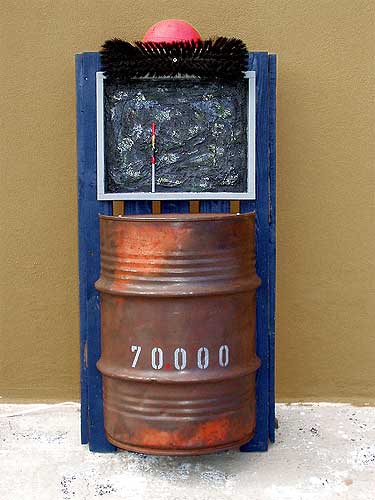 This work states the grim facts of an environmental catastrophe, although in ciphered form – the halved oil drum symbolizes the tanker “Prestige” that sank off the coast of Brittany with 70,000 tons of toxic freight. The audible song of the whale stands for the lament of the suffering creatures, while the broom signifies the immense efforts required to master such disastrous pollution. This work states the grim facts of an environmental catastrophe, although in ciphered form – the halved oil drum symbolizes the tanker “Prestige” that sank off the coast of Brittany with 70,000 tons of toxic freight. The audible song of the whale stands for the lament of the suffering creatures, while the broom signifies the immense efforts required to master such disastrous pollution.
The inserted picture visualizes the surface of the ocean with underlying bitumen, a derivative of crude oil, while a red ball symbolizes the scandalous global representation of egoistic financial interests.
Here again, the carrier material is a transport pallet as used again and again in a wide variety of contexts – in positive sense as an ideal transport medium, or negatively to symbolize one of today’s greatest environmental insanities – unnecessarily transporting all kinds of goods to and fro for purely financial reasons.
In February 2004 Heckmann held a retrospective exhibition showing more than 150 of his works dating back to 1972. These lead paintings, objects and installations, etchings, metal and wood sculptures demonstrated once again his incredible versatility and his complete mastery of so many different materials.
Norman Nescio
|
